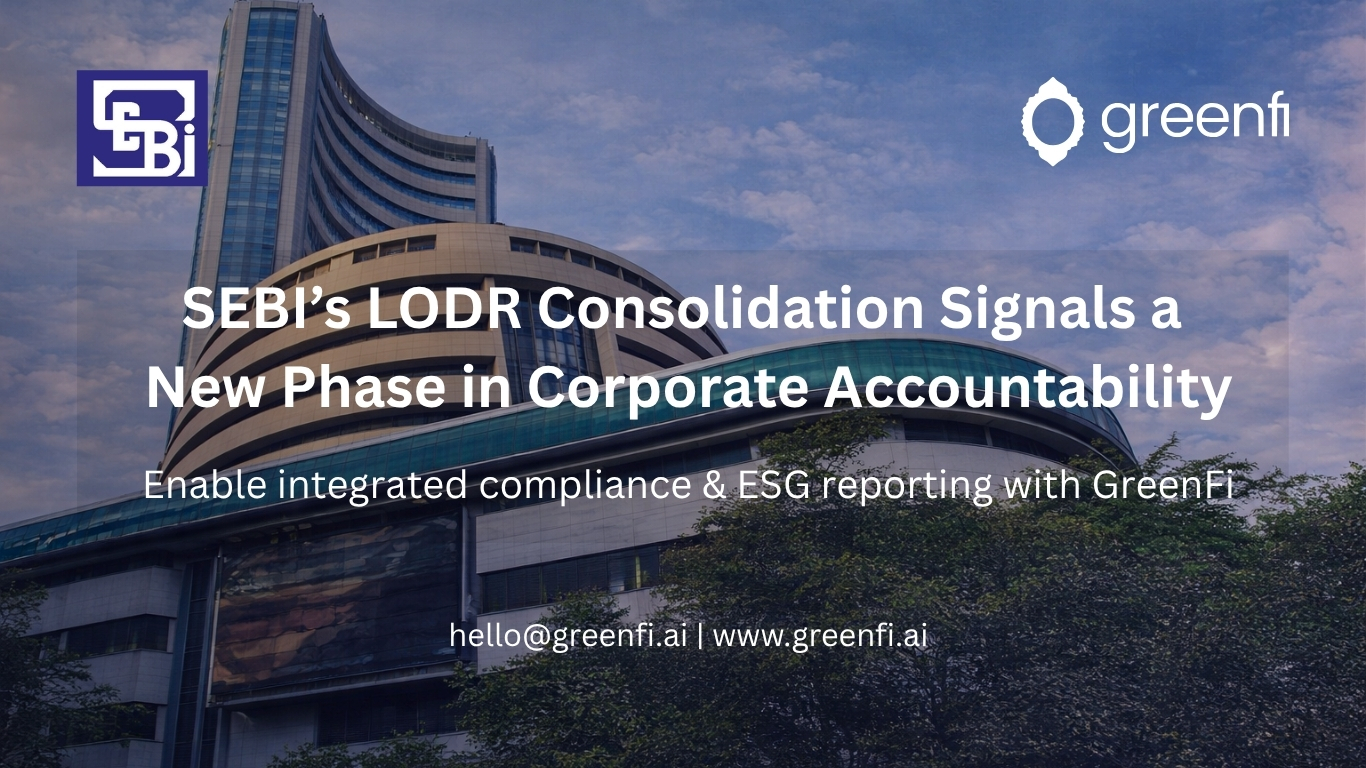
The Securities and Exchange Board of India (SEBI) has released an updated Master Circular on the Listing Obligations and Disclosure Requirements (LODR), consolidating multiple regulatory updates and amendments into a single 291-page framework.
While the circular simplifies regulatory navigation for listed companies, its implications go far beyond documentation efficiency.
It signals a structural shift in how corporate governance, sustainability reporting and regulatory compliance will operate in the coming years.
From Fragmented Disclosures to Integrated Governance
Historically, companies treated regulatory requirements as separate compliance streams – financial reporting, corporate governance disclosures, ESG reporting, and related party transaction monitoring.
SEBI’s consolidated LODR framework suggests these elements are now converging into an integrated disclosure ecosystem.
Key areas being increasingly interconnected include:
- Governance disclosures
- Financial reporting frameworks
- Related party transaction transparency
- Business Responsibility and Sustainability Reporting (BRSR)
- BRSR Core assurance
- Value chain ESG disclosures
- System-driven regulatory filings
This convergence reflects a broader regulatory shift toward structured, data-driven compliance systems.
Compliance is Becoming Infrastructure
For boards, CFOs, and compliance leaders, the biggest implication is operational rather than procedural.
Compliance is gradually moving away from periodic reporting exercises toward continuous data infrastructure.
Organisations will need systems capable of:
- Collecting ESG and governance data across departments
- Tracking value chain sustainability metrics
- Aligning financial controls with sustainability disclosures
- Ensuring audit-ready regulatory submissions
In other words, system readiness is becoming regulatory readiness.
BRSR Core Assurance and Supply Chain Transparency
One of the most significant developments in the updated framework is the phased rollout of BRSR Core assurance.
SEBI has indicated that BRSR Core verification will extend to the top 1000 listed companies by FY 2026–27.
Alongside this, value chain ESG disclosures are expanding, signaling an increasing regulatory focus on supply chain sustainability and transparency.
This evolution effectively moves ESG from a corporate reporting function to a value chain governance requirement.
The Strategic Opportunity for Organisations
Many organisations may interpret the updated circular as simply a consolidation of regulatory instructions.
However, the deeper implication is a transition toward integrated governance architecture, where financial, operational and sustainability data operate within a unified compliance framework.
Companies that treat this shift as a documentation exercise may struggle with increasing disclosure complexity.
Those that invest in digitised compliance systems, ESG data infrastructure and integrated governance workflows will be better positioned to navigate the evolving regulatory landscape.
The Key Question for Corporate Leadership
As SEBI moves toward standardised, digitised, and assurance-driven disclosures, organisations must ask:
Are we redesigning our internal controls for regulatory convergence or merely updating reporting templates?
At GreenFi, we believe this transition represents the next phase of corporate accountability – where financial integrity, sustainability performance and governance transparency are managed through unified data systems.
Schedule a call with us today: hello@greenfi.ai
Learn more: www.greenfi.ai