Japan has officially entered a new phase of corporate sustainability reporting.
In February 2026, Japan’s Financial Services Agency (FSA) finalized the Cabinet Office Order that transformed the Sustainability Standards Board of Japan (SSBJ) framework from a proposed guideline into a legally binding reporting standard. For companies listed on the Tokyo Stock Exchange (TSE), sustainability disclosures are no longer a voluntary communication exercise – they are now a core financial and compliance obligation.
This marks one of the most significant ESG regulatory shifts in Asia and places Japan firmly alongside global markets adopting International Sustainability Standards Board (ISSB)-aligned reporting frameworks.
For Japanese corporations, multinational enterprises, financial institutions, and supply chain partners operating in the region, the message is clear:
Sustainability data must now meet the same level of rigor, traceability and assurance as financial reporting.
Understanding the SSBJ Standards
The Sustainability Standards Board of Japan (SSBJ), established under the Financial Accounting Standards Foundation (FASF), was created to develop Japan’s national sustainability disclosure standards.
The framework is heavily aligned with the ISSB global baseline standards:
- IFRS S1 – General Sustainability-Related Financial Disclosures
- IFRS S2 – Climate-Related Disclosures
However, Japan has adapted these requirements into a structure designed specifically for its domestic reporting ecosystem.
The framework consists of three integrated standards:
- The Application Standard
This establishes the overall reporting framework, materiality boundaries, and how sustainability disclosures connect with financial statements.
- The General Standard
Aligned with IFRS S1, this focuses on sustainability-related risks and opportunities across governance, strategy, and enterprise risk management.
- The Climate Standard
Aligned with IFRS S2, this introduces detailed climate reporting obligations, including emissions accounting, transition planning, and climate risk disclosures.
The Four Core Pillars of Disclosure
The SSBJ framework adopts the globally recognized TCFD structure, requiring disclosures across four interconnected pillars:
- Governance
- Strategy
- Risk Management
- Metrics & Targets
This means companies must go beyond publishing sustainability narratives. They are now expected to demonstrate how climate and sustainability risks directly influence corporate governance, strategic planning, financial performance, and long-term enterprise value.
The Phased Rollout: Who Must Comply and When?
The implementation will occur in phases, beginning with the largest companies listed on the Tokyo Stock Exchange Prime Market.
Tier 1
- Approximately 69 companies
- Average market capitalization above ¥3 trillion
- Mandatory reporting begins for fiscal years ending March 31, 2027
- Mandatory assurance begins in 2028
Tier 2
- Approximately 110 companies
- Average market capitalization above ¥1 trillion
- Reporting begins in 2028
- Assurance begins in 2029
Tier 3
- Remaining Prime Market companies
- Expected implementation around 2029–2030
Foreign issuers listed in Japan may also be permitted to use equivalent ISSB-aligned global frameworks, subject to approval from the FSA.
Why the SSBJ Standards Are Different
Japanese companies have already been required to include basic sustainability information in annual securities reports since 2023. However, the SSBJ mandate dramatically increases the level of scrutiny, accountability, and technical detail.
- Granular Scope 3 Emissions Reporting
Under the new Climate Standard, companies must disclose Scope 3 emissions across all 15 GHG Protocol categories.
This represents a major operational challenge because emissions data must now be collected from suppliers, logistics providers, procurement systems, and downstream business activities with significantly higher accuracy and traceability.
For many organizations, Scope 3 reporting will become the single largest ESG data challenge.
- Financial Materiality and Data Connectivity
The SSBJ standards emphasize financial materiality – focusing on sustainability risks that materially affect enterprise value.
This creates a direct link between sustainability metrics and audited financial statements.
Climate risks, transition plans, carbon pricing assumptions, and operational exposure must now align with financial disclosures, investor communications, and risk management frameworks.
In practice, sustainability teams can no longer operate independently from finance teams.
- Mandatory Third-Party Assurance
To improve investor confidence and reduce greenwashing risks, Japan will gradually introduce mandatory third-party assurance requirements.
Initially, assurance requirements will focus on:
- Scope 1 and Scope 2 emissions
- Governance processes
- Internal controls
- Risk management systems
Over time, assurance coverage is expected to expand across broader sustainability datasets.
The Operational Challenge for Businesses
The transition to SSBJ compliance is not simply a reporting exercise – it is a transformation in how organizations collect, govern, and validate sustainability data.
Many companies still rely on spreadsheets, fragmented supplier surveys, and manually consolidated ESG reporting processes. These approaches are unlikely to meet the auditability and financial connectivity expected under the SSBJ framework.
Organizations will need to:
- Centralize ESG data collection
- Improve supplier data transparency
- Establish stronger internal controls
- Integrate sustainability metrics into enterprise systems
- Maintain defensible audit trails
- Build assurance-ready reporting workflows
The timeline is short, especially for Tier 1 companies preparing for 2027 disclosures.
GreenFi Helps Companies Prepare for SSBJ Compliance
As sustainability regulations evolve globally, organizations need more than reporting templates – they need intelligent ESG infrastructure.
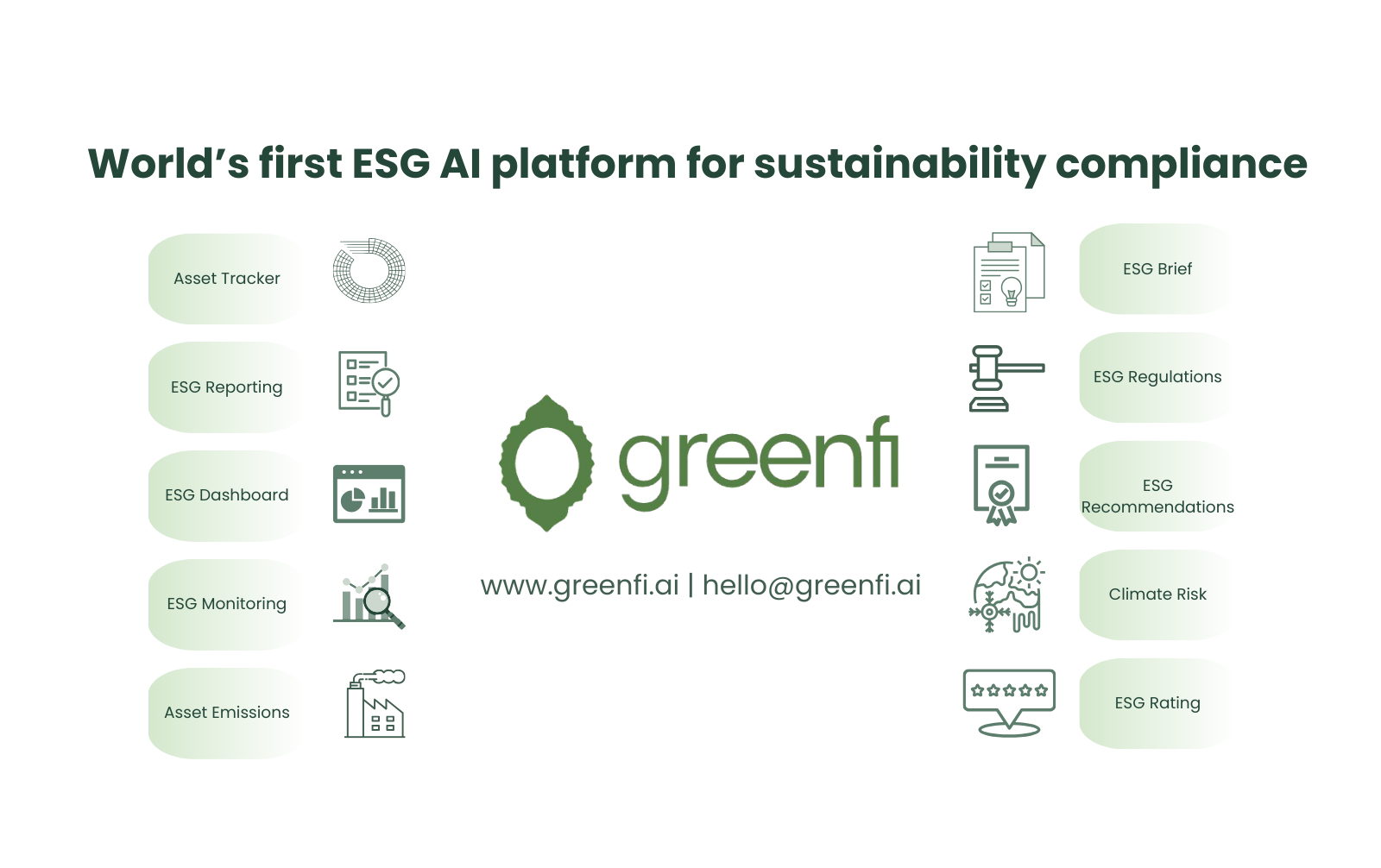
GreenFi helps enterprises streamline ESG and climate data management by combining automation, AI-powered intelligence, and audit-ready reporting workflows into a single platform.
With frameworks like SSBJ increasingly demanding financial-grade sustainability reporting, GreenFi supports businesses by:
- Automating Scope 1, 2, and 3 emissions calculations
- Mapping emissions across GHG Protocol categories
- Centralizing supplier and operational ESG data
- Improving data traceability and audit readiness
- Enabling framework-aligned reporting for ISSB, SSBJ, and other global standards
- Helping finance and sustainability teams collaborate through connected reporting workflows
As regulatory expectations tighten across Asia, Europe, and global capital markets, companies that invest early in scalable ESG infrastructure will gain a significant strategic advantage.
What Companies Should Do Next
Conduct a Detailed Gap Assessment
Evaluate whether current ESG reporting processes can support:
- Scope 3 category-level disclosures
- Financial-grade auditability
- Connected financial reporting
- Assurance readiness
Align Finance and Sustainability Teams
SSBJ reporting requires close coordination between:
- CFO offices
- Sustainability leaders
- Risk and compliance teams
- Procurement and operations
Strengthen Supply Chain Data Collection
Reliable Scope 3 reporting depends heavily on supplier participation. Organizations should establish standardized data-sharing frameworks as early as possible.
Build Assurance-Ready Processes
Internal controls, documentation standards, and transparent methodologies will become critical as third-party verification expands.
The Bigger Picture
Japan’s adoption of the SSBJ standards signals a broader global shift:
ESG reporting is evolving into regulated financial disclosure.
Investors increasingly expect transparent, comparable, and decision-useful sustainability information. Regulators are responding by demanding higher levels of rigor, consistency, and accountability.
For companies operating in Japan – or within Japanese supply chains – the transition has already begun.
Organizations that act early will not only reduce compliance risks but also strengthen investor confidence, improve operational resilience, and position themselves competitively in a rapidly changing global economy.
The future of sustainability reporting is no longer voluntary. It is financial, strategic and increasingly mandatory.
Schedule a call with us today: hello@greenfi.ai
Learn more: www.greenfi.ai