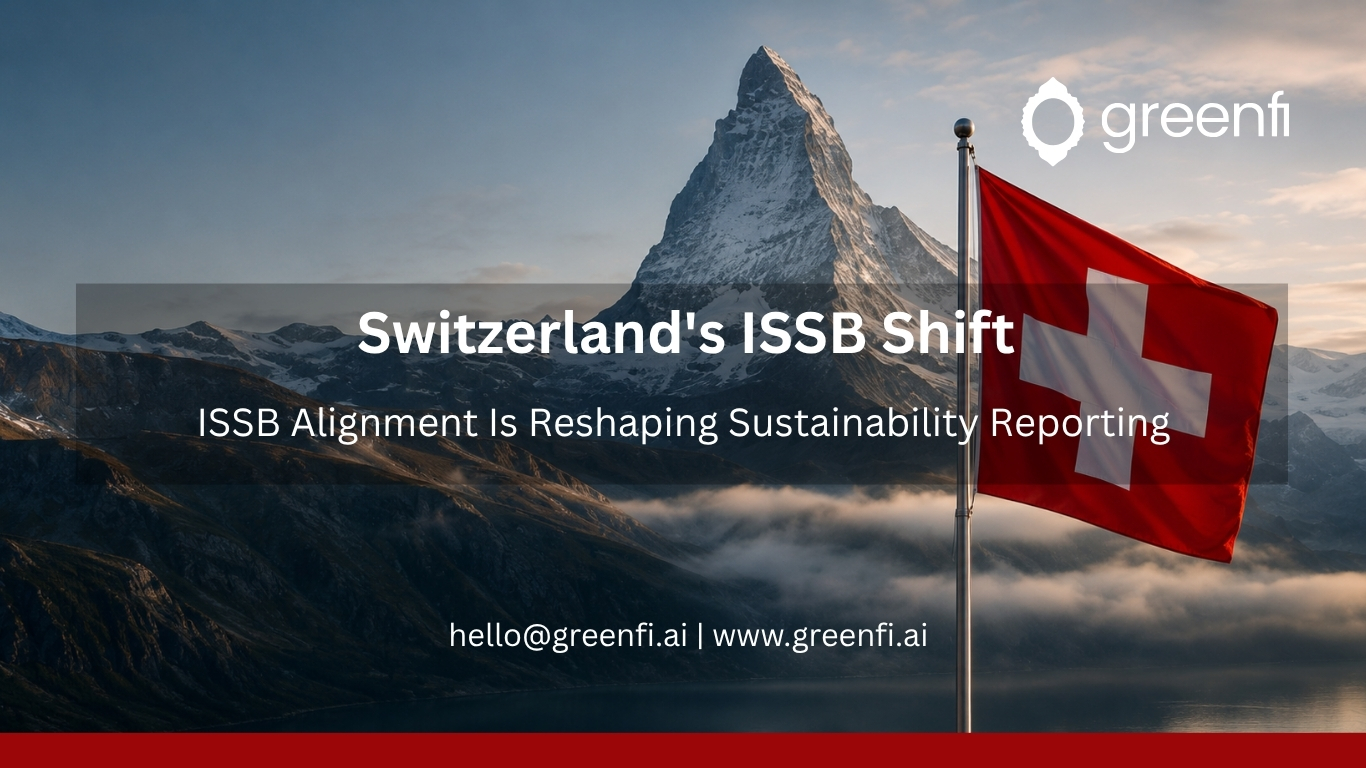
Switzerland’s move toward ISSB-aligned sustainability reporting is often framed as a regulatory development.
In reality, it is an operational one.
Most large companies already publish sustainability reports. Most already track ESG metrics. Many have spent years aligning with multiple frameworks and responding to investor questionnaires.
The challenge now is different.
ISSB is pushing sustainability reporting closer to financial reporting standards. The focus is shifting from narrative disclosures to data that can withstand scrutiny from investors, auditors, regulators and boards.
For many organizations, that exposes a problem that has been building for years.
The sustainability data infrastructure simply isn’t ready.
The Spreadsheet Era Is Reaching Its Limits
Despite growing reporting requirements, sustainability data inside many organizations remains highly fragmented.
Energy data sits with facilities teams.
Supplier data sits with procurement.
Climate risk assessments sit with sustainability teams.
Financial impacts sit with finance.
When reporting deadlines arrive, teams spend weeks manually collecting, reconciling, and validating information from multiple systems and stakeholders.
The process is resource-intensive, difficult to audit, and increasingly difficult to defend.
What worked for voluntary ESG reporting becomes far more challenging when disclosures are expected to be consistent, traceable, and financially material.
Scope 3 Remains the Weakest Link
For Swiss companies with global supply chains, Scope 3 emissions continue to be one of the largest reporting challenges.
Data often comes from suppliers spread across multiple countries, industries, and reporting standards.
Information quality varies significantly.
Methodologies differ.
Evidence is often incomplete.
Organizations are being asked to report emissions that originate far beyond their direct operational control while maintaining confidence in the underlying data.
The result is a growing gap between disclosure expectations and data availability.
Sustainability Is Moving Into Finance
The most important shift under ISSB is not sustainability-related.
It is financial.
Climate risks, transition risks, and sustainability-related opportunities are increasingly expected to be assessed through the lens of enterprise value.
This means sustainability information can no longer sit in separate reports managed once a year.
It must become part of the same governance, risk management, and reporting processes used for financial information.
For many organizations, sustainability reporting is becoming a finance infrastructure challenge rather than a sustainability reporting exercise.
Boards Need Defensible Numbers
Board members are facing increasing pressure to oversee sustainability disclosures with the same level of confidence expected for financial reporting.
That requires more than collecting data.
It requires understanding where data originated, how it was calculated, what assumptions were used, and whether results can be independently verified.
The question is no longer whether a company has disclosed sustainability information.
The question is whether the organization can defend it.
As assurance requirements increase and investor scrutiny intensifies, defensibility becomes just as important as disclosure itself.
The Next Competitive Advantage
The organizations that adapt fastest are unlikely to be those producing the longest sustainability reports.
They will be the ones building reliable sustainability data infrastructure.
Centralized data management.
Automated evidence collection.
Continuous monitoring.
Clear audit trails.
Integrated financial and sustainability reporting.
These capabilities are becoming strategic assets rather than compliance tools.
Where GreenFi Fits
At GreenFi, we see this shift firsthand.
The challenge is rarely understanding what needs to be reported.
The challenge is collecting accurate data, validating it across multiple stakeholders, mapping it to reporting requirements, and producing disclosures that can withstand external scrutiny.
As Switzerland moves closer to ISSB alignment, sustainability reporting is evolving from a reporting exercise into a data management challenge.
Organizations that continue relying on spreadsheets and fragmented processes will face increasing costs, risks and reporting complexity.
Those that invest in robust sustainability data infrastructure today will be better positioned to meet regulatory expectations, strengthen investor confidence, and turn compliance into a competitive advantage.
Schedule a call with us today: hello@greenfi.ai
Learn more: www.greenfi.ai