For years, sustainability sat in a corner of the boardroom that nobody really wanted to fund. It was the right thing to do, the responsible thing to do, the thing every annual report mentioned somewhere near the back. But when budgets got tight, sustainability spend was the first to get cut.
That has changed. According to Verdantix’s 2026 ESG predictions, more CFOs this year will demand clear ROI before committing to any sustainability initiative. Sustainability leaders are now expected to sit with finance teams and link every project to efficiency, cost savings, or revenue growth and the shift is real.
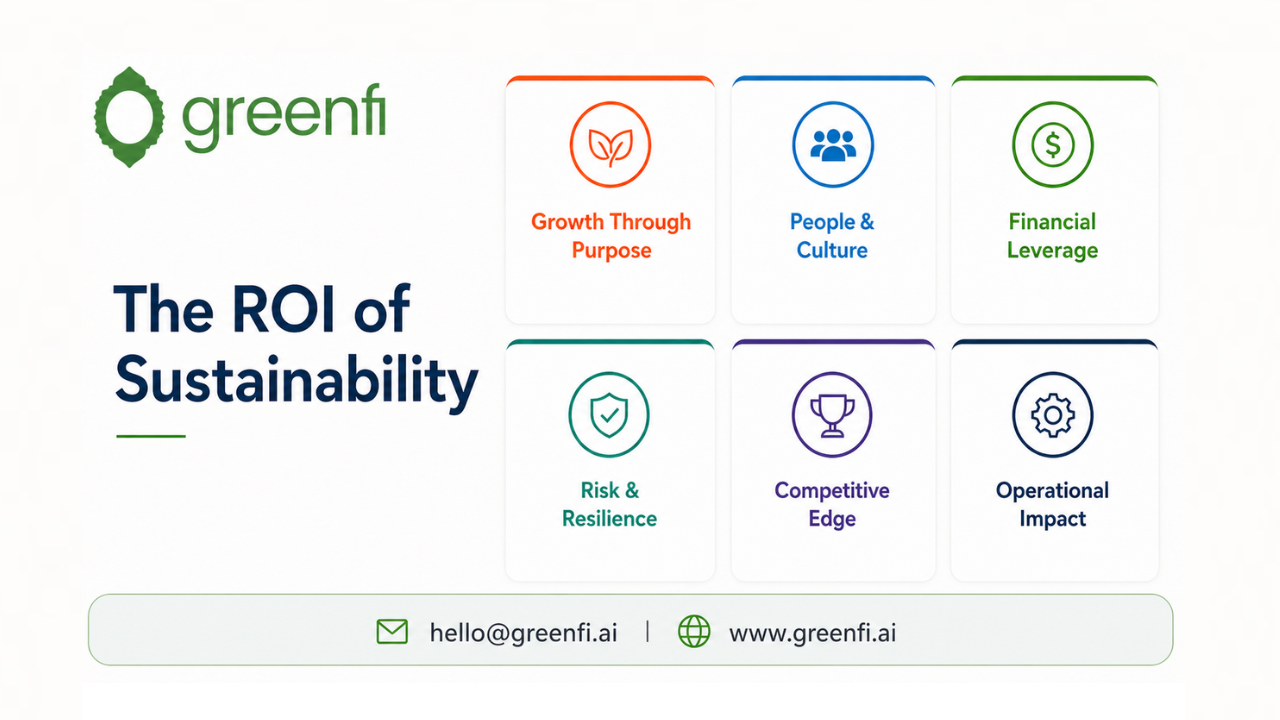
Growth Through Purpose:
Companies that lead with a clear sustainability story are growing faster than the ones that don’t. McKinsey research shows products that make ESG-related claims are growing disproportionately compared to products that don’t. Customers are voting with their wallets, and increasingly, they want to know the brand behind the product is doing the right thing.
This is not just consumer goods. From banking to real estate to industrial supply, buyers across every category are starting to filter on sustainability before they filter on price. Companies that build purpose into their growth strategy are finding new markets, new partnerships, and new revenue streams that simply did not exist five years ago.
People & Culture:
Talent is choosing sustainability too. The next generation of employees, especially in technical and leadership roles, want to work for companies whose values match theirs. Strong sustainability practices reduce attrition, improve retention, and lower hiring costs.
Beyond that, employees in sustainability-led companies report higher engagement and pride in their work. That shows up in productivity, in customer service, and in how people speak about their employer outside the office. As we explored in our piece on why your supply chain could be your biggest ESG risk, people and culture are deeply tied to how a company shows up across its entire ecosystem, not just its head office.
Financial Leverage:
This is where sustainability is hitting bottom lines hardest. PlanA reports that companies with high ESG scores receive an average 10% discount on their cost of capital compared to companies with low scores. Banks, insurers, and institutional investors are pricing ESG performance into every funding decision.
Green bonds, sustainability-linked loans, and ESG-focused funds are growing rapidly. Companies that can prove their sustainability data is real, audited, and continuous are getting cheaper money. Companies that can’t pay a premium without realising it. The cost of not having clean ESG data is now showing up directly in interest rates.
Risk & Resilience:
Sustainability is also the strongest risk shield a company can build. Climate risk, regulatory risk, supply chain risk, and reputational risk are all becoming more frequent, more severe, and more expensive. The Fortune 500 alone carries an estimated $2 trillion in climate-related financial risk according to outside-in ESG analysis.
Companies with mature sustainability practices spot risks earlier, recover faster, and avoid the kind of headlines that wipe out years of brand value in a week. Whether it is a flood disrupting a factory, a regulator demanding emissions data, or a buyer pulling out of a contract over a human rights audit, resilience is built in advance, not after the fact.
Competitive Edge:
The sustainability gap between leaders and laggards is widening. ESG leaders saw that the 8% higher returns than the broader market in 2021, and that gap has continued to grow. In sectors like fashion, food, and finance, sustainability credentials are now table stakes for winning enterprise contracts.
EU buyers are screening suppliers on ESG data. Asian manufacturers are losing contracts to suppliers who can produce verified emissions reports. Indian listed companies are using BRSR Core scores in their investor pitches. The companies that move first are building moats their competitors will struggle to cross.
Operational Impact:
Finally, sustainability simply makes operations leaner. McKinsey’s analysis on sustainability and value creation shows that greening operations and supply chains is one of the biggest value levers, through energy savings, waste reduction, and smarter resource use. These are not vague long-term gains. They show up on the next quarter’s P&L.
Less water used. Less energy consumed. Less waste sent to landfill. Less raw material wasted. Each of these is a direct cost reduction that compounds year after year. Once a company starts measuring and managing its sustainability data properly, it usually finds operational savings it did not know were sitting there.
The Common Thread:
All six of these returns share one thing in common. None of them happen without good data. Growth claims need verified product footprints. Capital discounts need audited disclosures. Risk monitoring needs continuous tracking. Operational savings need accurate baselines. Without clean, real-time, defensible sustainability data, none of these returns can be claimed, proven, or repeated.
This is the gap most companies are sitting in right now. They believe in sustainability. They are spending it. But they cannot yet prove the return.
That’s Where GreenFi Comes In:
GreenFi’s AI-powered sustainability platform brings together ESG data from across operations, automates continuous monitoring, and produces audit-ready reporting that meets BRSR, ISSB, CSRD, and global standards. It turns sustainability from a cost centre into a measurable ROI engine, with every number traceable, verifiable, and ready for the next investor, regulator, or buyer who asks.
The CFOs demanding ROI in 2026 are right to ask the question. The companies with the data to answer it are the ones that will lead the next decade.
Schedule a call with us today: hello@greenfi.ai
Learn more: www.greenfi.ai