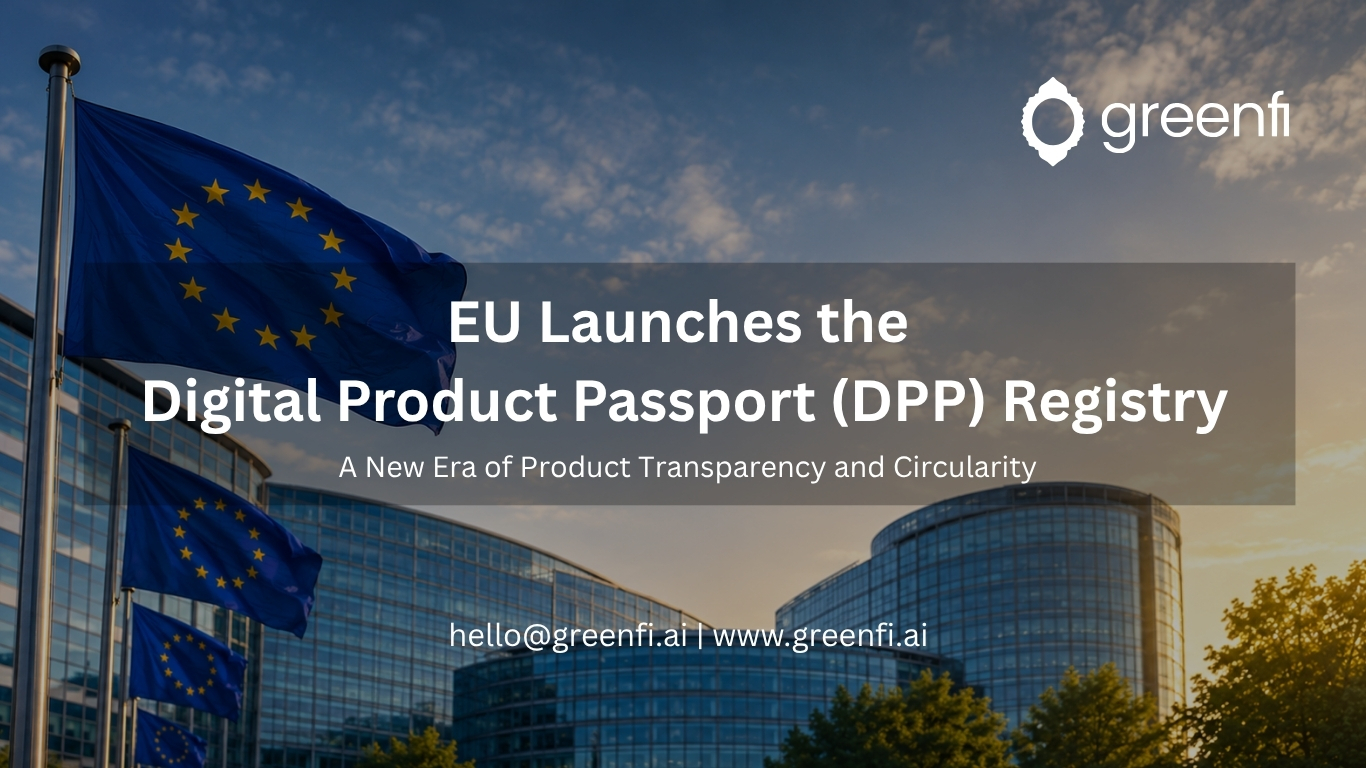
The European Union has reached a major milestone in its sustainability journey with the official launch of the Digital Product Passport (DPP) Registry on 20 July 2026. Introduced under the Ecodesign for Sustainable Products Regulation (ESPR), the Registry provides the digital infrastructure needed to make product information accessible, interoperable, and trustworthy across the European Single Market.
Alongside the Registry, the European Commission also launched:
- A dedicated Digital Product Passport Portal
- A Sandbox (Testing Environment) for developers and businesses
- API Documentation
- User Implementation Guides
- A dedicated Business Helpdesk
These resources provide the digital infrastructure and implementation support needed for the phased rollout of Digital Product Passports across the European Union, helping manufacturers, importers, and technology providers prepare for future compliance requirements.
What is the Digital Product Passport?
A Digital Product Passport (DPP) is a standardized digital record containing information about a product throughout its lifecycle.
Instead of relying on fragmented documentation, every regulated product will have a digital identity that can be accessed through a unique identifier – such as a QR code or another approved data carrier – providing relevant information to manufacturers, suppliers, regulators, customs authorities, recyclers, businesses, and consumers.
The Digital Product Passport is designed to:
- Improve product transparency
- Enable circular economy practices
- Strengthen supply chain traceability
- Simplify regulatory compliance
- Support informed purchasing decisions
As implementation progresses, the DPP is expected to become a foundational digital infrastructure supporting product transparency, sustainability, and circularity across the European Union.
Understanding the DPP Registry
One of the most common misconceptions is that the DPP Registry stores every product’s sustainability information.
It does not.
Rather than storing product information itself, the DPP Registry functions as a secure indexing service that enables authorized stakeholders to locate Digital Product Passports across the European ecosystem.
The Registry stores:
- Product unique identifiers
- Registration metadata
- Links to where the Digital Product Passport is hosted
The complete passport data remains with:
- Manufacturers
- Importers
- Authorized Digital Product Passport (DPP) Service Providers
This decentralized architecture allows organizations to maintain ownership and control of their product data while ensuring interoperability across the European market.
What Information Can a Digital Product Passport Include?
Depending on the applicable product-specific legislation, a Digital Product Passport may include information such as:
- Material composition
- Recycled content
- Carbon footprint
- Environmental impacts
- Supply chain traceability
- Repairability information
- Maintenance instructions
- Product lifecycle information
- Compliance certificates
- End-of-life guidance
- Recycling instructions
Future delegated acts may introduce additional sector-specific data requirements for different industries. The exact data fields will vary depending on the product category, ensuring that each Digital Product Passport contains information relevant to its environmental, technical, and regulatory requirements.
Why the Digital Product Passport Matters
The Digital Product Passport represents much more than another compliance requirement. It fundamentally changes how product information is shared throughout the value chain.
Enhanced Supply Chain Transparency
Businesses can access standardized product information across suppliers, making ESG reporting, procurement, and due diligence significantly more efficient.
Stronger Circular Economy
Repair, refurbishment, reuse, and recycling become easier when detailed product information is available throughout the product’s lifecycle, helping products remain in circulation for longer.
Better Consumer Trust
Consumers gain greater visibility into the sustainability characteristics of products, enabling more informed purchasing decisions and increasing confidence in sustainability claims.
Simplified Regulatory Compliance
Organizations can manage compliance information digitally instead of maintaining multiple disconnected documentation systems, improving efficiency and reducing administrative complexity.
Improved Cross-Border Interoperability
Standardized data structures allow information to move seamlessly across manufacturers, suppliers, regulators, and customers throughout the European Single Market.
Which Industries Will Be Affected?
The Digital Product Passport framework will be introduced gradually through delegated acts under the Ecodesign for Sustainable Products Regulation (ESPR) and other relevant EU legislation.
Product categories expected to be covered include:
- Textiles
- Iron and steel products
- Aluminium products
- Furniture
- Tyres
- ICT and electronic products
- Energy-related products
The Registry also supports Digital Product Passports introduced under other EU legislation, including:
- Large batteries
- Construction products
- Toys
- Detergents
- End-user surfactants
Rather than applying to every product immediately, implementation will occur progressively through sector-specific delegated acts, with each product category having its own technical requirements and compliance timelines.
The Road Ahead
The launch of the DPP Registry establishes the digital foundation for Digital Product Passports, but implementation will continue in phases over the coming years.
Key Milestones
| Timeline | Milestone |
| 20 July 2026 | Digital Product Passport Registry becomes operational |
| 18 February 2027 | Digital Product Passports become mandatory for certain battery categories under the EU Battery Regulation |
| 2027 onwards | Additional product categories introduced through delegated acts under the ESPR and other applicable legislation |
This phased approach provides businesses with time to prepare while allowing product-specific technical requirements to mature.
What Does the Registry Launch Mean for Businesses?
A common misconception is that the July 2026 launch requires every business to immediately register Digital Product Passports.
That is not the case.
The Registry provides the digital infrastructure needed to support future implementation. Product-specific registration obligations will only become applicable when the relevant delegated acts for each product category enter into force.
However, the launch sends a clear signal that businesses should begin preparing now. Organizations that establish strong product data management practices today will be better positioned to meet future compliance requirements while improving transparency, operational efficiency, and supply chain resilience.
How Businesses Can Prepare
Organizations that manufacture, import or sell products within the European Union should begin building the capabilities needed for Digital Product Passports.
Key preparation steps include:
- Assess the availability and quality of product sustainability data.
- Map material composition and lifecycle information across products.
- Strengthen supplier data collection and traceability processes.
- Establish governance for product and sustainability data.
- Prepare systems to generate, maintain, and update Digital Product Passports throughout the product lifecycle.
- Evaluate technology solutions that support interoperability with the DPP ecosystem.
- Monitor upcoming delegated acts applicable to relevant product categories.
Early preparation will not only simplify future compliance but also improve operational efficiency, strengthen supply chain visibility, and enhance sustainability reporting.
How GreenFi Supports the Journey
As sustainability regulations become increasingly data-driven, organizations need more than reporting tools – they need trusted data management capabilities.
GreenFi helps organizations build a strong foundation for sustainability by enabling them to:
- Centralize ESG and sustainability data
- Improve supply chain transparency
- Collect and validate supplier information
- Track carbon emissions and environmental performance
- Strengthen data governance and reporting processes
- Build the data foundation needed to support evolving Digital Product Passport requirements and other sustainability regulations
By establishing reliable, structured sustainability data today, businesses can better adapt to tomorrow’s regulatory landscape while improving operational performance and stakeholder trust.
Looking Ahead
The launch of the Digital Product Passport Registry marks the beginning of a new chapter in sustainable product management across Europe. By creating a standardized digital infrastructure for product information, the European Union is laying the foundation for greater transparency, improved traceability, stronger circular economy practices and more efficient regulatory compliance.
For businesses, the Digital Product Passport is more than a compliance initiative – it represents an opportunity to improve product data quality, strengthen supply chain collaboration and build trust with customers, investors and regulators.
As sustainability regulations become increasingly digital and data-driven, the Digital Product Passport represents a shift from static compliance documentation to connected, lifecycle-based product information. Businesses that invest early in high-quality product and ESG data will be better positioned to meet evolving regulatory expectations, strengthen supply chain transparency, and unlock long-term value in a more sustainable and circular economy.
Schedule a call with us today: hello@greenfi.ai
Learn more: www.greenfi.ai