Every serious ESG risk tool is built to answer one question well: has something gone wrong with this company? They scan the world’s news in dozens of languages, catch the incident, score it and drop an alert in your inbox. For finding the signal in the noise, they’re genuinely good and the best of them have spent nearly two decades getting there.
But catching the incident was never the hard part of ESG risk. The hard part is everything that happens after the alert.
When a supplier gets flagged for a labour issue, or a counterparty turns up in an adverse-media report, the alert doesn’t tell you which of your loans it touches. It doesn’t map the incident to the specific regulation – CSRD, EUDR, a supply-chain due-diligence law that now applies. It doesn’t chase the supplier for a response, update your climate and ESG reporting or leave an audit trail that your assurance provider will accept. All of that lands on a person, who does it by hand, across a stack of spreadsheets, usually against a deadline.
So the tool solves maybe ten per cent of the problem and hands you the other ninety.
There’s a second gap, too, and it’s about who gets to play. The strongest risk feeds are priced for the largest banks in the world. If you’re a regional bank, an NBFC or a mid-sized corporation, a six-figure data subscription is out of reach, so you monitor manually or not at all. Risk exposure doesn’t scale down politely just because your budget did.
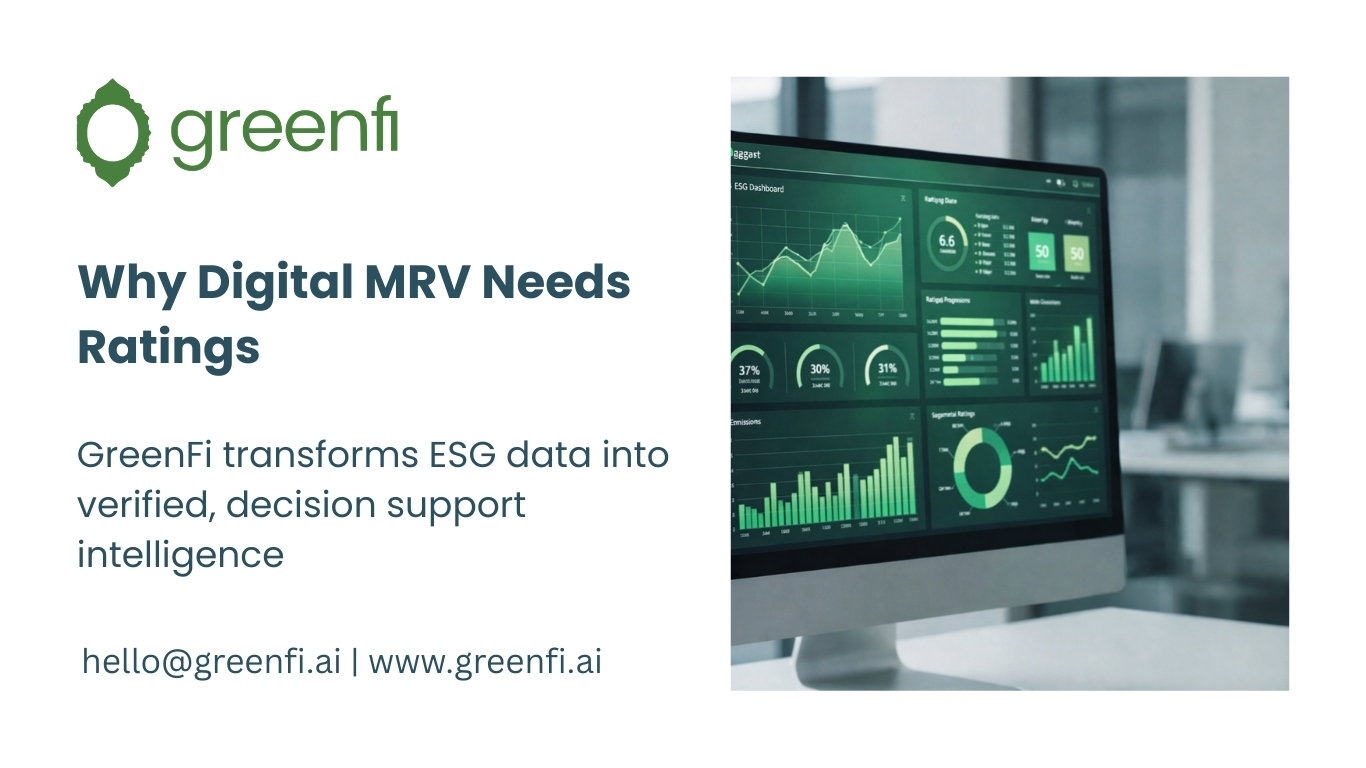
GreenFi was built to close both gaps. The monitoring is there – the same job of catching incidents that matter. But the alert doesn’t stop at your inbox. It routes itself to the obligation it triggers, flags the supplier inside the same platform you use for supplier checks and flows into reporting that’s already audit-ready. One system, one trail, from signal to resolution. And because monitoring rides on the same platform as your carbon accounting, reporting and compliance, it’s priced for the institution you actually are, not just for the Tier-1s.
There’s one more thing a data-only feed can’t do, by design. Most of them deliberately ignore what a company says about itself, on the sound principle that self-reported figures can flatter. GreenFi holds both sides, your own ESG data and the external signals. So it can reconcile them. When an external source questions a green claim, we can check it against the number you actually reported. That reconciliation is where credible ESG assurance is heading, and you can’t get there looking only from the outside in.
Flagging the risk is the easy half. Closing the loop, reporting it, fixing it and proving it is the half that actually protects you. That’s the half we built.
GreenFi is an AI-powered ESG, carbon accounting and compliance platform. If your team is spending more time acting on ESG alerts than the alerts save you, that’s the conversation we’d like to have.
Schedule a call with us today: hello@greenfi.ai
Learn more: www.greenfi.ai