Introduction
Corporate climate accountability is expanding beyond energy consumption and operational emissions. As businesses face growing expectations to measure and disclose their environmental impact, land use, agricultural supply chains, and carbon removals are receiving increased attention.
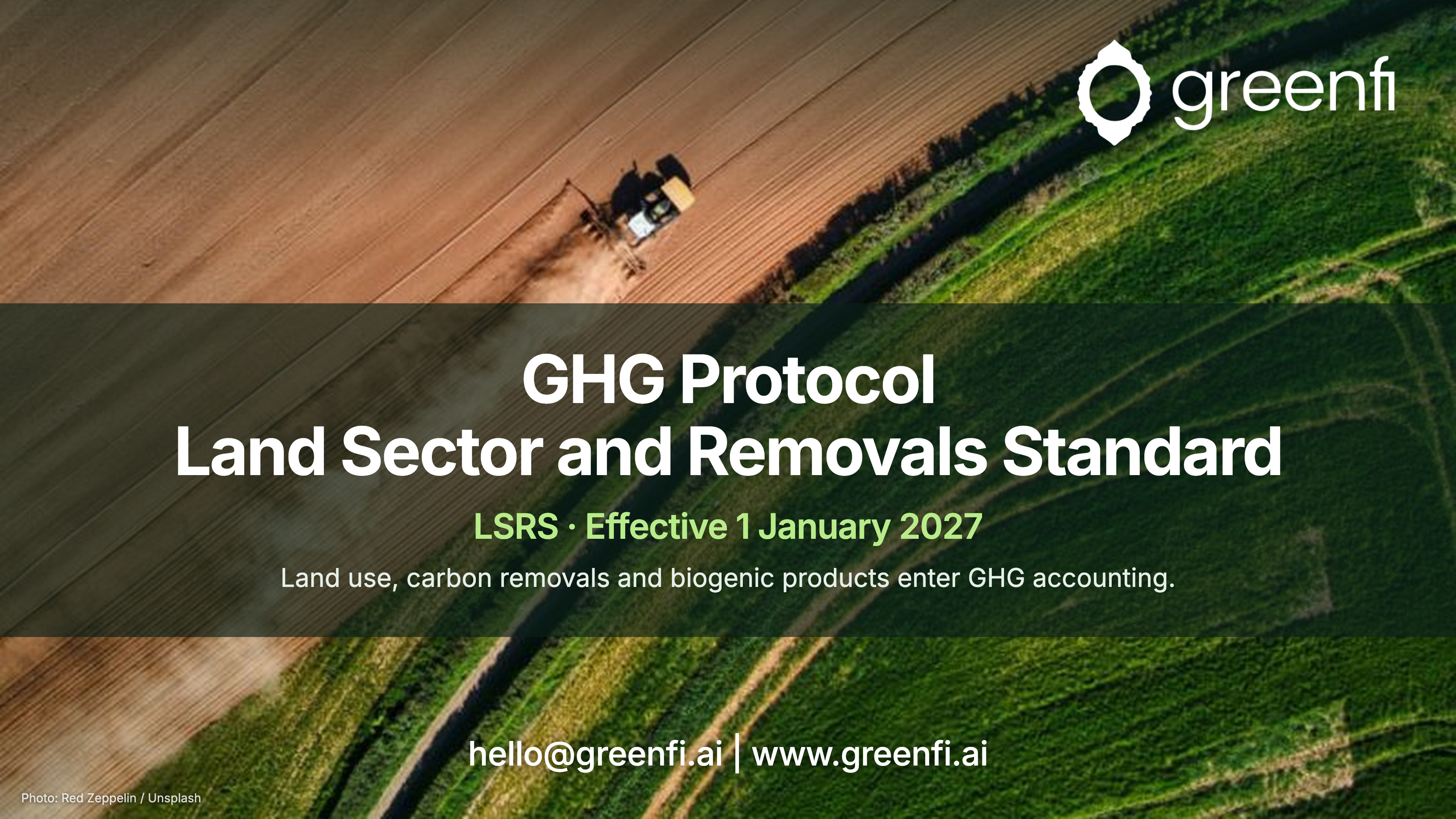
The GHG Protocol’s Land Sector and Removals Standard (LSRS) represents an important step in this direction. Scheduled to take effect on January 1, 2027, the standard is designed to strengthen how companies account for greenhouse gas emissions and carbon removals associated with land-related activities.
For businesses operating in food and beverage, agriculture, consumer goods, biofuels, forestry, and other land-intensive sectors, this shift brings an important question to the forefront: Are existing emissions accounting processes equipped to capture land-sector impacts accurately and transparently?
Preparing for 2027 requires more than updating reporting templates. It calls for better data, stronger supply-chain traceability, and credible systems for measuring and monitoring emissions and removals.
Understanding the Land Sector and Removals Standard
The GHG Protocol provides widely used frameworks for measuring and reporting greenhouse gas emissions. Its Land Sector and Removals Standard addresses an area of corporate climate accounting that can be particularly complex: the relationship between land management, agricultural production, land-use change, and the removal of carbon dioxide from the atmosphere.
Unlike emissions from fuel combustion or purchased electricity, land-sector emissions can depend on changing environmental conditions, agricultural practices, soil characteristics, and activities across geographically dispersed supply chains.
Carbon removals also require careful accounting. Businesses need to distinguish between emissions reductions and the removal of carbon dioxide from the atmosphere, while ensuring that their claims are supported by appropriate evidence and accounting methods.
The LSRS aims to provide a more consistent basis for accounting for these impacts, helping businesses improve the transparency and credibility of their climate reporting.
Note: Companies should consult the official GHG Protocol publications for the final requirements, applicable transition provisions, and implementation timelines.
Why the LSRS Matters for Businesses
- Land-sector emissions are a critical part of the climate footprint
For many businesses, a substantial share of their environmental impact occurs outside their direct operations.
Food manufacturers depend on agricultural ingredients. Consumer goods companies source commodities such as palm oil, soy, paper, cotton, and other land-based materials. Biofuel producers rely on feedstocks whose environmental impacts may be influenced by cultivation practices and land-use change.
These activities can generate emissions associated with land conversion, soil management, fertiliser use, and other agricultural processes.
Companies that focus exclusively on operational emissions may therefore miss important parts of their overall climate footprint.
A more comprehensive approach to emissions accounting helps businesses understand where their impacts occur and which interventions could deliver meaningful reductions.
- FLAG emissions require greater attention
Forest, Land and Agriculture (FLAG) emissions are particularly relevant to companies with significant agricultural or land-based supply chains.
FLAG-related impacts can include emissions from deforestation, land-use change, agricultural production, and soil-related processes. Depending on the activity, land-sector accounting may also need to consider carbon removals.
For organisations with complex sourcing networks, collecting this information can be challenging. Data may be spread across suppliers, farms, processors, and intermediaries, often with different levels of accuracy and traceability.
Preparing for the LSRS means identifying where FLAG-related emissions are material, understanding existing data gaps, and establishing reliable processes for collecting and validating information.
- Carbon removal claims need credible evidence
Carbon removals are increasingly relevant to corporate climate strategies. However, not all removal claims are equivalent, and measuring removals can involve significant methodological and data challenges.
Companies need to understand the underlying activity, the carbon pools involved, the measurement approach, and the evidence supporting reported outcomes.
They must also avoid treating emissions reductions and carbon removals as interchangeable. Reducing emissions at source remains a distinct objective from removing carbon dioxide from the atmosphere.
Stronger accounting practices can help businesses communicate their climate performance more transparently and reduce the risk of unsupported environmental claims.
Which Industries Should Prepare?
Although the relevance of the LSRS will vary by company and activity, several sectors should pay particular attention.
Food and beverage: Agricultural ingredients, fertiliser use, land management, and commodity sourcing can contribute significantly to supply-chain emissions.
Agriculture and agribusiness: Crop production, soil management, land-use change, and farming practices can influence both greenhouse gas emissions and carbon removals.
Consumer goods and retail: Businesses sourcing agricultural commodities, textiles, paper, timber, and other land-based materials may need better visibility into supplier-level environmental impacts.
Biofuels and renewable energy: Feedstock sourcing and land-use impacts can influence the overall climate performance of biofuel pathways.
Forestry and land-based businesses: Land management, forest carbon stocks, and carbon removal activities can create specific accounting and monitoring requirements.
For these organisations, the first step is to assess how much their climate footprint depends on land-related activities and where more detailed accounting may be necessary.
Five Steps Businesses Can Take Before 2027
The transition to stronger land-sector accounting should begin with an assessment of existing emissions data, systems, and processes.
- Identify material land-sector impacts
Review the organisation’s operations, purchased materials, and supply chains to identify activities associated with land use, agriculture, forestry, and carbon removals.
This assessment should help determine which business units, commodities, suppliers, and geographies require closer attention.
- Strengthen supplier data collection
Reliable land-sector accounting depends on the quality of underlying data.
Businesses should evaluate whether their current systems capture relevant information from suppliers, including sourcing locations, agricultural practices, land-use information, and emissions-related activity data where applicable.
Where primary data is unavailable, companies should establish a transparent approach to using appropriate secondary data and documenting assumptions.
- Improve traceability across supply chains
Traceability helps businesses connect environmental data to the activities and locations responsible for emissions.
Organisations can begin by mapping key suppliers, identifying high-impact sourcing regions, and improving visibility into commodity origins.
Better traceability can also support supplier engagement, risk identification, and more targeted sustainability interventions.
- Review emissions accounting and carbon removal methodologies
Existing greenhouse gas inventories should be assessed against the applicable LSRS requirements once confirmed in the relevant official guidance.
Businesses should review their accounting boundaries, data sources, calculation methods, treatment of land-related emissions, and approaches to measuring carbon removals.
Clear documentation and internal review processes will be important for supporting consistent and verifiable reporting.
- Build audit-ready processes
Data should be traceable from its source through calculation, review, and final disclosure.
Companies should maintain records of data sources, assumptions, methodologies, revisions, and approval workflows. Defined responsibilities across sustainability, procurement, operations, finance, and technology teams can further improve accountability.
Starting early gives organisations more time to address data gaps, engage suppliers, and integrate new requirements into existing reporting systems.
The Role of Technology in LSRS Readiness
As sustainability reporting becomes more data-intensive, spreadsheets and fragmented reporting processes can make it difficult to maintain consistency across business units and supply chains.
Technology can help organisations centralise ESG information, standardise data collection, automate calculations where appropriate, monitor changes, and maintain supporting evidence.
For land-sector emissions, useful capabilities may include:
- Centralised ESG data management: Bringing emissions, supplier, and sourcing information into a structured environment.
- Supply-chain visibility: Connecting relevant environmental information to suppliers, commodities, and business activities.
- Emissions calculation and monitoring: Supporting consistent methodologies, documented assumptions, and repeatable calculations.
- Evidence management: Maintaining source records and calculation histories to support internal reviews and assurance.
- Risk identification: Highlighting data gaps, high-impact activities, and areas requiring further investigation.
Technology does not replace sound accounting methodologies or reliable primary data. Instead, it helps organisations apply their chosen methodologies more consistently and manage the growing complexity of sustainability information.
How GreenFi Supports Sustainability Data Readiness
At GreenFi, we believe sustainability data should be more than a reporting exercise. It should help businesses understand their environmental impacts, identify risks, prioritise interventions, and make better decisions.
GreenFi combines ESG advisory and technology to help organisations manage sustainability information, monitor regulatory developments, and strengthen ESG reporting processes.
As businesses prepare for evolving land-sector emissions accounting expectations, a structured approach to ESG data can help teams identify information gaps, improve internal coordination, and build more transparent reporting workflows.
The objective is not simply to produce another disclosure. It is to create a stronger foundation for credible climate action and informed business decisions.
Looking Ahead: From Reporting to Accountability
The move towards more comprehensive land-sector emissions accounting reflects a broader change in corporate climate accountability.
Businesses are increasingly expected to understand not only the emissions generated by their own operations but also the environmental impacts embedded in their supply chains and the credibility of their carbon removal activities.
For companies exposed to agriculture, forestry, land use, and land-based commodities, preparing for the LSRS is an opportunity to improve data quality, strengthen supplier relationships, and integrate climate considerations into procurement and business strategy.
With January 2027 approaching, organisations should begin by reviewing their current accounting practices, identifying material data gaps, and establishing a practical implementation plan aligned with the applicable requirements.
The next phase of climate accountability will depend on more than reporting emissions. It will depend on understanding where they come from, how they are measured, and what businesses can do to address them.
Is your organisation ready for the next phase of land-sector emissions reporting?
Explore how GreenFi can help your team strengthen ESG data management and prepare for evolving sustainability reporting expectations.
Contact: hello@greenfi.ai